

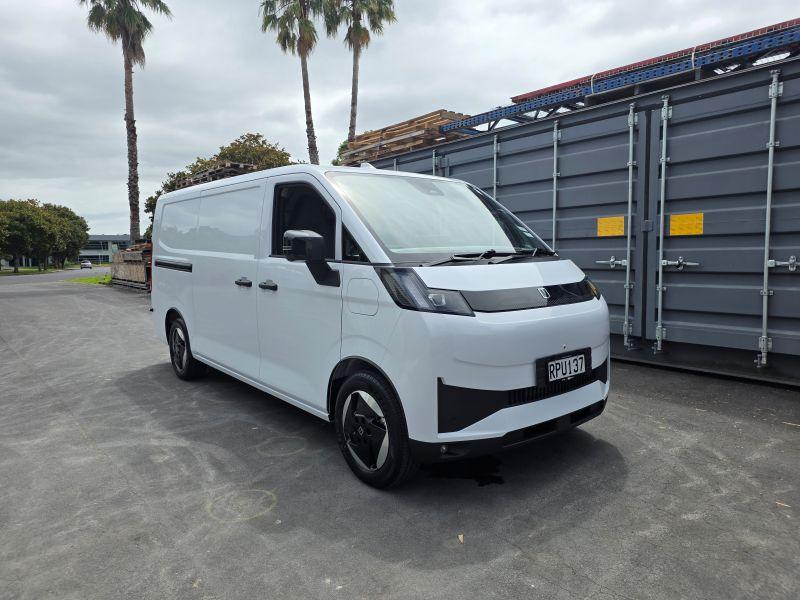
The light‑commercial EV segment has become very relevant in recent years, driven by rising fuel and serving costs, urban delivery demand, emissions restrictions, and the rapid maturation of commercial‑grade battery technologies. However, upfront buy prices have been a barrier to this smart-business choice. Well, what if a better spec’d EV van was parity priced the fossil-fueled segment goto? Enter the Farizon V7e.
At around 5m long, 1.99m tall and 1.82m wide, the Farizon V7e is a medium‑size, fully electric logistics van developed by Geely and aimed squarely at modern city‑centric fleets. Designed to maximise cargo usability, efficiency, and driver comfort, the V7e represents a compelling evolution of what an electric van can be: practical, well thought‑out, and genuinely pleasant to operate.
The Farizon V7e takes a pragmatic approach to exterior design, favouring urban usability over unnecessary flourishes. Its most striking functional advantage is the narrow, semi‑abrupt front end, which dramatically improves manoeuvrability in tight city environments. Visibility is excellent thanks to a tall windscreen and supplementary A‑pillar windows that allow drivers to see downward into blind spots, ideal for navigating busy loading zones or inner‑city congestion.
Large door windows give a commanding view, though the driver's side mirror is noticeably smaller than the passenger’s and doesn’t open outwards as wide, slightly compromising visibility on that side. Even so, visibility remains better than most ICE‑based vans.
Around the back, the V7e shines with practicality: twin sliding doors (one on each side) and dual 270‑degree rear doors that open to create a “tall access” cargo entryway, perfect for couriers and tradespeople who load and unload frequently. The low, flat aluminium floor enhances durability, and the wide‑open architecture allows the van to comfortably swallow two Euro pallets; they even fit between the wheel arches.
Farizon’s aerodynamic efficiency efforts also pay off: with a drag coefficient of 0.27 Cd, the V7e is among the most streamlined vans in its class, boosting both range and stability at speed.
Despite being designed primarily as a commercial tool, the V7e’s cabin feels surprisingly modern and well considered. The cloth seats are a practical touch, breathable and better suited for long workdays than the slippery vinyl used in many vans. The real bonus, heated AND ventilated seating, which is almost unheard of in this segment and greatly boosts all‑season comfort.
Storage is plentiful, with a large glove box, multiple small cubbies, a dual‑cupholder armrest, plus USB and USC connectivity. There’s no overhead shelf, a minor omission for courier‑focused use cases, but overall practicality remains high.
The van also offers keyless entry, but notably lacks a traditional start/stop button, once seated, you simply pull the drive stalk, and you’re ready to go. In fact, this quirk even allows the V7e to be driven without a seatbelt engaged (if the stalk is pulled twice) likely appreciated by courier drivers making frequent short stops (though definitely not recommended from a safety standpoint).
Farizon’s cabin layout focuses on simple usability. The air‑conditioning uses physical buttons for core functions, while other controls sit on a medium‑sized touchscreen that is easy to operate and not overloaded with unnecessary apps.
Instrumentation is handled by a square, clear digital cluster displaying speed, battery state, and consumption figures. During test driving, real‑world efficiency hovered around 21.7 kWh/100 km, though this was unladen and higher than the official rating.
The Farizon V7e takes a pragmatic approach to in‑cabin tech too. The 12.3 inch central touchscreen provides access to vehicle settings and connectivity features without distracting from the job at hand. The digital instrument cluster is a simple 7‑inch unit that prioritises clear and essential data delivery.
Active safety systems are plentiful. The van features a raft of driver‑assistance technologies including, speed alert warnings, driver concentration monitoring, lane departure and lane keep assist, forward collision warning (FCW), automatic emergency braking (AEB). Some of these can be switched off, but many will default back on at startup, a common trait in modern commercial EVs designed to encourage safer fleet driving. Yes you do get frequent beeps from the ADAS systems, though you do get used to it (or have the ability to dumb them down).
The V7e’s powertrain highlights Farizon’s commercial EV expertise. Rather than chasing headline‑grabbing power figures, Farizon focuses on predictable, efficient torque delivery optimised for stop‑start urban usage. Powering this versatile van is a 66.67kWh battery and 100kw electric motor combo, offering plenty of thrust and torque. It boasts a low energy consumption WLTP figure of 22.4kWh/100km, which unladen, I managed to better, achieving 21.4kWh/100km.
Then comes the all important question of range. I picked up the V7e with 100% charge and 326km on display. I travelled 59km and had 263km of predicted range left so 63km of real world (albeit not overly efficient throttle usage) coverage. Basically concluding that the 326km of range is more than possible. What’s more its 2C liquid‑cooled high‑rate charging, allowing 30% to 80% in only 15 minutes, gives the V7e one of the best charge‑to‑range ratios in the light‑electric-van category.
As if this wasn’t good enough, where the V7e truly excels is in cargo practicality. With 7.0 cubic metres of storage volume and up to 1,243kg of payload capacity, it lands squarely in the sweet spot for couriers, trades, and last‑mile delivery fleets. With a length of 2,865mm, height of 1,435 and max width of 1,690mm, this EV van has the largest cargo box in its class,easily big enough for 2 pallets.
The highlights include, dual sliding doors for both‑sides access , wide 270‑degree rear barn doors, low, flat (in my review model) aluminium floor for durability, integrated tie‑down points and evening‑friendly cargo lighting. Added to this, the loading platform height of just 500 mm is a major ergonomic advantage, reducing lift strain during repetitive loading cycles.
On the move, the V7e impresses. Steering feel is light and predictable, though not particularly communicative, typical for commercial vans. The turning circle is tight enough for confident city manoeuvres, helped by the compact nose and excellent forward visibility.
Wind noise is notably low, and the suspension feels secure and confidence‑inspiring even without cargo weight. Farizon’s tuning seems to prioritise a balance of firmness and comfort that suits both urban roads and occasional motorway travel.
Acceleration is a pleasant surprise, the van is quick off the line, making traffic merging and short‑range bursts feel effortless. Farizon includes Normal and Eco drive modes, with Eco dialing up regenerative braking for improved efficiency.
Drivers may notice the ADAS beeps and nudges more than in a traditional ICE van, but this is increasingly par for the course in modern EVs. Overall, the V7e feels modern, secure, and more refined than many fleet buyers may expect.
A Well‑Rounded, Future‑Ready Urban Electric Van
The Farizon V7e combines practical design, thoughtful ergonomics, and efficient electric performance into a compelling package for modern commercial fleets. Its strong visibility, excellent cargo access, comfortable and tech‑forward interior, fast charging, and stable driving dynamics all reflect a van purpose‑built for urban logistics.
Farizon may not yet be a household name in some markets, but based on real‑world impressions and the published specs, the V7e stands as one of the most well‑rounded electric vans in the mid‑size category, deal for fleets looking to transition to clean, efficient, and driver‑friendly EVs.
Final Thoughts
The move to EV vans may not be immediate but it does seem inevitable, particularly for those that do most of their business in and around town (although 320km+ range is not to be sniffed at). I strongly recommend that you run the numbers, if you take away range anxiety and purchase price objections (as the Farizon V7e has), what you have left is a smooth and very well optioned van, that (depending on how/when/where you charge) gives you zero fuel costs and minimal service fees, that surely makes a compelling business argument against the segment go to - as expressed in the headline, Parity +, the V7e is Ace.
This article was published in the 2026 Fleet Buyers Guide